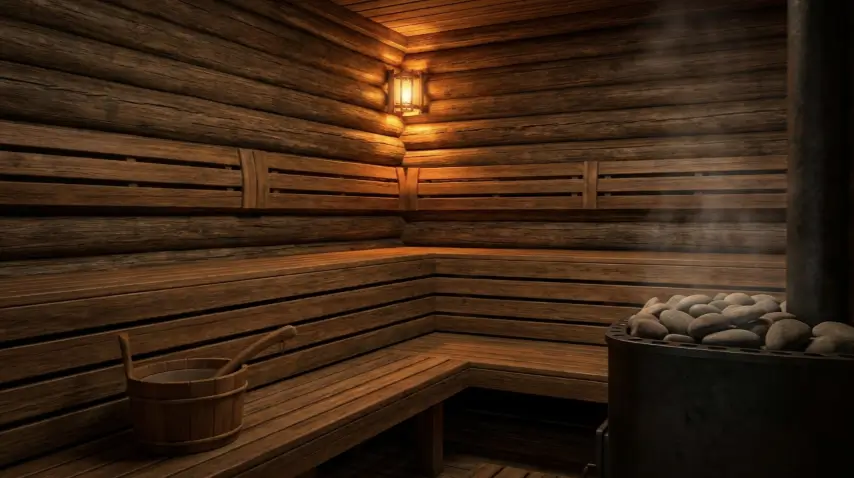
What a Traditional Sauna Costs to Run Each Month on a Budget

A traditional sauna heated electrically and used four times a week typically adds $15 to $35 a month to a home power bill, depending on heater wattage, session length, and local electricity rates. A wood-fired traditional sauna used at the same frequency usually costs $10 to $25 a month in seasoned cordwood. The gap between a cheap month and an expensive one almost always comes down to three things: how often the sauna runs, how well the cabin holds heat, and which fuel type is heating the stones.
How Much Electricity Does a Traditional Sauna Heater Actually Draw?
A typical home traditional sauna heater for a two- to four-person cabin runs 6 to 9 kilowatts. Reaching a working temperature of roughly 170 to 190 degrees Fahrenheit from a cold start usually takes 30 to 45 minutes at full draw, after which a thermostat cycles the element on and off to hold temperature for the rest of the session. Running a 7-kilowatt heater for a 45-minute heat-up plus a 30-minute hold, with the element actually firing maybe 60 percent of that time, works out to roughly 4.5 kilowatt-hours per session. At a national average residential rate near 16 cents per kilowatt-hour, that is about 70 to 75 cents a session, or nine to twelve dollars a month at three sessions a week. Households in higher-rate states, or those running longer sessions with guests, will land toward the higher end of the $15 to $35 range.
What Does a Wood-Fired Traditional Sauna Cost in Fuel?
A wood-fired stove sized for a similar cabin burns through roughly a third to half a face cord of seasoned hardwood over a month of regular use, three to four sessions a week. Seasoned oak, ash, or birch runs $80 to $150 a face cord delivered in most regions, which puts monthly fuel cost somewhere between $15 and $40 if every stick is purchased. Households that split their own wood from a wood lot or standing dead trees can push that closer to zero in raw dollars, though the labor and truck time are a real cost most people do not track. Wood-fired stoves also demand more attention per session: building and tending a fire, monitoring the flue, and cleaning ash out periodically, none of which shows up on a utility bill but does show up as time.
How Much Does Cabin Insulation and Sealing Change the Bill?
Kiln-dried cedar or spruce with tight tongue-and-groove joinery and a properly gasketed door holds heat far better than a cabin with gaps between boards or a door that does not seal. A drafty cabin can take 20 to 40 percent longer to reach working temperature and loses heat faster between sessions, which means the heater or stove works harder for the same result. Bench height also plays a role, since heat stratifies and the upper bench can run 20 to 30 degrees hotter than the lower one, so a well-designed cabin with correctly spaced benches lets users get comfortable heat without cranking the thermostat to compensate for a cool lower bench. Checking door seals and re-caulking any gaps in exterior board joints once a year is one of the cheapest ways to keep monthly running cost from creeping up.
Does Session Frequency Matter More Than Heater Size?
Yes, and by a wide margin. A household that saunas twice a week spends roughly half of what a household saunaing five to seven times a week spends, because both electricity draw and wood consumption scale almost directly with total heated hours per month. This matters when budgeting, because two households with identical cabins and identical heaters can report very different monthly costs simply based on how often they actually use the thing. Anyone shopping for a traditional sauna should think honestly about realistic weekly use before comparing running-cost estimates between electric and wood-fired options, since a heavy user will notice fuel cost far more than an occasional user will.
Electric or Wood-Fired: Which Fits a Tight Monthly Budget Better?
For most households, electric heat wins on convenience and wood wins on raw fuel cost, assuming a source of affordable seasoned wood is nearby. An electric heater needs a dedicated 240-volt circuit installed once, after which running cost is predictable and shows up as a line item on the power bill. A wood-fired stove needs dry storage for cordwood, more maintenance, and more supervision during a session, but rewards anyone with access to cheap or free wood. Buyers comparing traditional cabins and heaters side by side, including options in the SweatDecks catalog alongside other established sauna retailers, should ask for the heater’s rated wattage and, for wood-fired models, the stove’s firebox size, since both numbers drive the real monthly number far more than the sticker price of the cabin itself.
What Does the Research Say About Regular Sauna Use?
Beyond the budget question, a body of Finnish cohort research has looked at what regular sauna use is associated with over time. A large prospective study found that men who used a sauna four to seven times a week had lower rates of fatal cardiovascular events and all-cause mortality compared with men who used one only once a week, an association that held after adjusting for other cardiovascular risk factors. A related analysis found that the combination of frequent sauna bathing and higher cardiorespiratory fitness was linked to a further reduction in cardiovascular and all-cause mortality risk. Separately, short-term studies of blood markers in regular sauna users found measurable acute changes in cardiovascular function markers following a sauna session. These are population-level associations from mostly Finnish cohorts, not proof that sauna use prevents disease in any one person, and none of it should be read as a reason to skip a conversation with a doctor for anyone managing a heart condition.
Frequently Asked Questions
How much does it cost to run a traditional sauna every month? For a household using an electric-heater traditional sauna four times a week, expect roughly $15 to $35 a month in added electricity, depending on heater size and local rates. A wood-fired traditional sauna at the same frequency typically runs $10 to $25 a month in seasoned cordwood.
Is a wood-fired heater cheaper to run than an electric one? Often yes on raw fuel cost, especially with self-sourced wood, but it takes longer to heat and needs more tending per session. Electric costs more per session but is faster and needs no fuel storage.
Does insulation really change the monthly bill by much? Yes. A poorly sealed door or thin walls can add 20 to 40 percent to heat-up and recovery time, directly increasing electricity draw or wood use for the same number of sessions.
What is the single biggest factor in monthly running cost? Session frequency. A household using the sauna twice a week spends roughly half of what a daily-use household spends, since fuel cost scales almost linearly with total heated hours.
References
- Association between sauna bathing and fatal cardiovascular and all-cause mortality events, JAMA Internal Medicine, 2015
- Joint associations of sauna bathing and cardiorespiratory fitness on cardiovascular and all-cause mortality risk: a long-term prospective cohort study, Annals of Medicine, 2018
- Short-term effects of Finnish sauna bathing on blood-based markers of cardiovascular function in non-naive sauna users, Heart and Vessels, 2018
By Meredith Cole